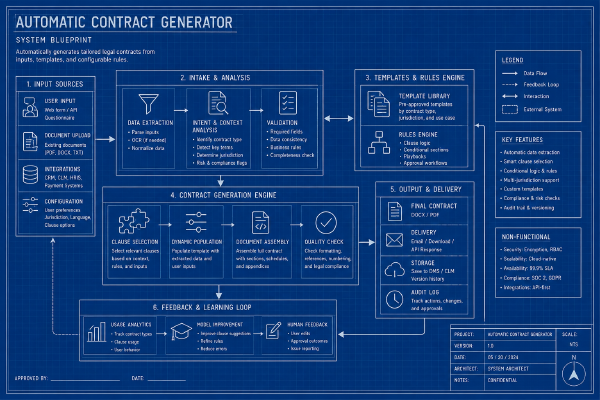
We’ll need a frontend, so that the end user can use the automatic contract generator. On entering, frontend should load all the Trello lists, where all tasks have been completed. If there’s a list with incomplete tasks, then it shouldn’t appear in the options for generating a PDF. User should be able to generate a PDF, and preview the result in the browser.
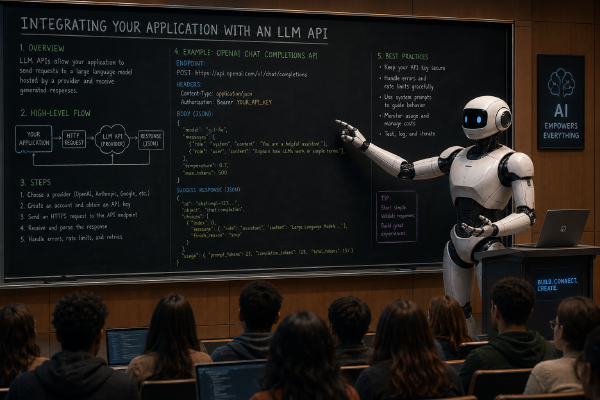
Today the plan is to hook up our backend to an LLM API. We’ll be using the LLM API to generate a contract as a Word/PDF. To do that, we’ll provide the Trello data, along with a contract template for the LLM API to build our contract.
To re-iterate on what the next 3 steps are in the current plan, it is: 1. A Java program that can call the Trello API. 2. Extend the Java program to call OpenAI’s API. 3. Test the quality of the generated contracts. And today we’re going to be looking making a Java program that can call the Trello API.
When you install a code agent on your system, you are basically inviting a guest into your house, and trusting that said guest doesn’t take your keys or credit cards, or tells outsiders where your keys are, or what your credit card information is.
Before we begin building the project, we should have a battle plan: What should we name the project, what’s the core issue, etc. At the end of this article, we’ll have a plan for the next steps, that we can follow up on in the next couple of articles.
Mr. J has expressed, that one of the biggest pain points, is having to assemble a contract from the various Trello tasks. For this, we could make an Automatic Contract Generator. If we can get an example of a Trello board and a contract, we should be able to make a solution, that can call the Trello API, collect the data and merge it into a contract.
Today I had the pleasure of meeting a pair of estate owners, that runs a business of arranging weddings, Christmas markets, and other events at their estate. They presented their current setup that their company uses to keep track of progress of individual events, and with that, the issues that comes with the current solution they are using. Their company primarily uses Trello as progress board, but a lot of their processes and workflows are time consuming and manual labour. A little automation or use of AI could probably help them with some of their burdens. And that’s where we come in.
Specification-Driven Development (or Spec-Driven Development) is an approach, where the spec is used as the primary artifact to develop the software. A spec is a document that contains the product requirements.
In this article, I will show how to create an AI-driven application. The goal is to create an application, that can integrate with an LLM-API. We want to make an application that can take an internship report as input, and in return receive an assessment of the report as output.
Code agents - AI systems that go beyond answering questions to autonomously build and execute tasks. It explains how they differ from traditional assistants, explores different types of agents, and demonstrates their capabilities by creating and deploying a full meditation quiz app from a single prompt.
RAG (Retrieval Augmented Generation) is an AI technique that improves answers by combining information retrieval from external sources with language model generation. It helps overcome limitations of standard models by providing up-to-date, accurate, and context-specific responses.
This project shows you how to fully automate your chatbot’s knowledge so it never falls behind. Every time you publish new content, your chatbot instantly learns it—no manual updates, no maintenance headaches.