What is MCP?#
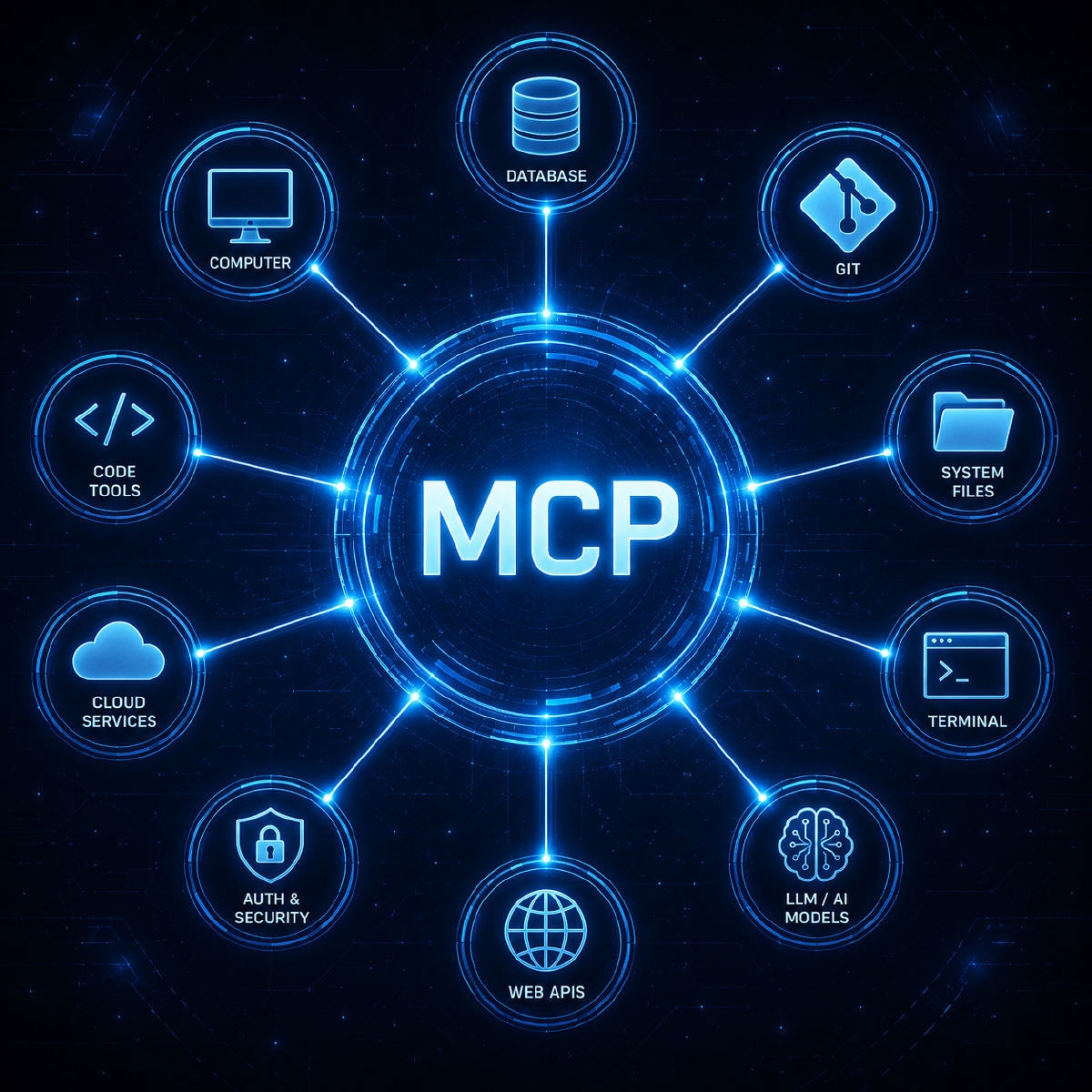
MCP (Model Context Protocol) is an open standard protocol for connecting AI applications to external systems, data sources, tools and workflows.
It acts as a universal bridge between AI applications and data sources and tools.
For example, you could hook up a code agent to Figma with MCP, so that your agent can have direct access to your designs, and have the code agent build a frontend that looks exactly like the Figma design.
MCP architecture consists of:
- MCP Host: The AI application that manages one or multiple MCP clients
- MCP Client: A component that maintains a connection to an MCP server
- MCP Server: A program that provides context to MCP clients
Using the same example with a code agent and Figma:
| MCP Component | Example |
|---|---|
| MCP Host | Code Agent (OpenAI Codex, Claude Code) |
| MCP Client | Open AI/Claude Code’s built-in MCP connector |
| MCP Server | Figma |
Transport layer#
MCP supports two transport mechanisms:
STDIOtransport- Uses standard input/output streams
- Used for direct process communication between local processes
- Provides optimal performance with no network overhead
- Typically serves a single MCP client
- Streamable
HTTPtransport- Uses
HTTP POSTfor client-to-server messages - Enables remote server communication
- Supports standard HTTP authentication methods (Bearer tokens, API keys, custom headers)
- Typically serves many MCP clients
- Uses
Benefits#
- MCP makes it easy to build and integrate an AI to an external system
- MCP is an open standard, so it is broadly supported
- MCP has real-time context access
What we’ve learned#
- MCP is an open standard for connecting AI applications to external systems
- MCP architechture consists of a host, client and a server
- MCP supports
STDIOtransport and streamableHTTPtransport